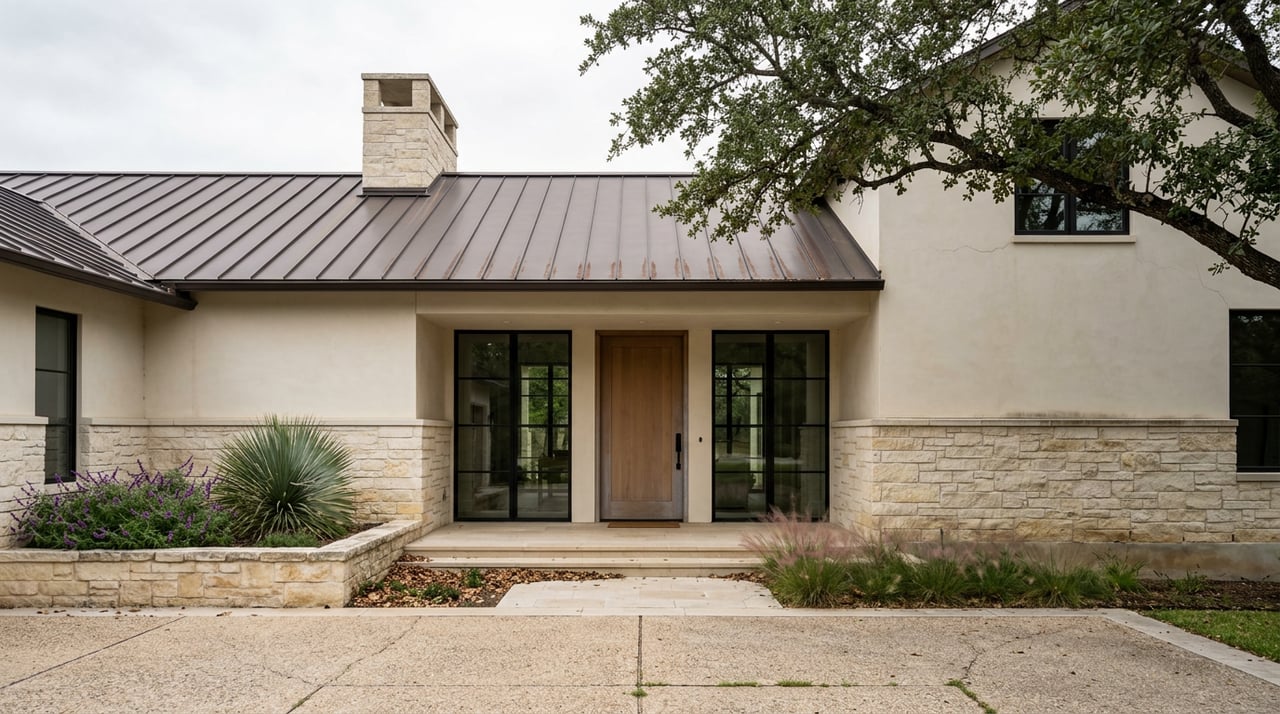
Why Two Nearly Identical Homes in Fredericksburg Can Have Very Different Price Tags
September 24, 2026
September 24, 2026
Two homes sit a block apart in Fredericksburg. Same era, same square footage, same three bedrooms and two baths, same distance to Main Street. One of them can legally take Airbnb bookings and produce a second income stream on top of resale value. The other, by the letter of the city code, may never be allowed to.
The difference has nothing to do with either house. It has to do with what sits on the other side of the fence.
Fredericksburg's short-term rental ordinance contains a rule that most buyers never hear about until they're deep into a purchase, and it changes what a property is actually worth in a way the county's median price cannot capture. If you're comparing Fredericksburg to Llano, Blanco, or Dripping Springs on a spreadsheet of median prices, you're missing the fracture running through this specific market.
Under Fredericksburg's short-term rental framework, a property in an R1 or R2 residential zone that wants to operate as an unoccupied short-term rental, meaning nobody lives there full-time and the whole house goes to guests, has to clear an adjacency test. The property must share two property lines with land that's already zoned C2, CBD, or Public Facility, or that already carries an STR-unoccupied permit. On top of that, at least half of the properties within a 200-foot radius have to carry that same qualifying status.
In plain terms: your house doesn't get to decide its own STR eligibility. Your neighbors do.
This is why two homes on the same block can land in completely different categories. One sits near enough to downtown's commercial edge, or near enough to other permitted rentals, to clear the threshold. The other sits one street further into a purely residential pocket and simply can't, no matter how nice the renovation or how strong the comps look on paper. The rule was built to keep unoccupied short-term rentals from clustering inside quiet residential blocks, and it works exactly as designed. It also means the rental-income upside a listing photo implies may not legally exist for that specific parcel.
Gillespie County's dollar volume for the first half of 2026 ran well ahead of the first half of 2025, but the number of individual properties that changed hands barely moved. What actually happened is that a handful of high-end sales, including transactions in the Boot Ranch community, pulled the total upward while the buyer count stayed almost flat. The same buyers, spending more.
That's the county-level version of the same problem. A single price sits at the top of the chart and quietly averages together properties that have nothing in common: a ranch tract with no rental ambitions, an in-town home that can legally chase Airbnb income, and an in-town home a block away that can't. None of that shows up until you ask the zoning question directly.
If you're shopping Fredericksburg the way you'd shop any other Hill Country market, by scanning a median and a per-square-foot number, you're comparing three different products as if they were one.
Here's the part that makes the timing matter right now. Even where a property clears the adjacency test and holds a valid STR permit, that permit isn't the guaranteed cash machine it was a few years ago.
Fredericksburg's short-term rental market has been adding supply faster than it's adding revenue. Over the twelve months ending in mid-2026, active STR listings in Fredericksburg grew roughly 7 percent while total STR revenue across those listings fell more than 15 percent. More licensed properties are splitting a shrinking pool of nightly bookings. Third-party rental data from 2026 puts median host revenue in Fredericksburg around $39,000 a year with occupancy near 44 percent, while top-performing properties still clear $61,000 or more. That spread tells you the permit hasn't lost all its value, but it has stopped being a rising tide that lifts every eligible property equally.
Meanwhile, ordinary in-town home prices in Fredericksburg's city limits softened by about 3 percent on a per-square-foot basis between 2025 and the first half of 2026, according to local brokerage reporting pulled from Central Hill Country MLS data. That's a small move by national standards, smaller than the roughly 7 percent pullback Austin has seen this year, but it's unusual for Fredericksburg, where in-town values have historically held steady. Rising inventory, some of it tied to national homebuilders entering the market, is part of the story. So is a rental market that's no longer absorbing new supply as easily as it once did.
Put those two threads together and you get a more precise picture than "the median is down slightly." The in-town homes that qualify for STR permits are exposed to a softening rental economy layered on top of a softening resale market. The in-town homes that don't qualify are competing purely as owner-occupied housing, insulated from the STR slowdown but also unable to capture any of its upside.
None of this touches raw land and ranch acreage, which is worth separating out because it's easy to lump "Fredericksburg real estate" into a single category when it isn't one.
Land transactions in Gillespie County actually slowed in count during the first quarter of 2026 compared to the same period in 2025, dropping from 26 individual raw land tracts to 19. But total acreage sold nearly doubled, from about 254 acres to about 446 acres, because the deals that did happen were larger. Average price per acre held nearly flat, moving from roughly $53,268 to $54,446. Buyers chasing acreage in Gillespie County right now are going bigger, not more numerous, and they're paying about the same per acre for the privilege. That's a market driven by legacy and lifestyle motivations, not by rental math, and it hasn't flinched the way in-town STR-adjacent pricing has.
| If the property is... | What actually determines its STR ceiling |
|---|---|
| Inside city limits, R1 or R2 zoning | Whether it shares two property lines with existing STR-unoccupied, C2, CBD, or Public Facility zoning, and whether half the properties within 200 feet already qualify |
| Inside city limits, C2, CBD, or Public Facility zoning | Not subject to the same neighbor-based adjacency test |
| In Fredericksburg's extraterritorial jurisdiction (ETJ) or unincorporated Gillespie County | No city STR permit required at all, though state and county hotel occupancy tax still applies |
The practical move, if short-term rental income is part of why you're looking at a specific address, is to confirm zoning and adjacency status before you get emotionally attached to the listing photos. The city maintains a public short-term rental map that cross-references licensed addresses against active Airbnb and VRBO listings, which is a faster way to see what's already permitted nearby than trying to eyeball zoning lines yourself.
If STR income isn't the point and you're after a primary residence or a weekend place, the same rule works in your favor. A block where the adjacency test fails is, by definition, a block that will stay quieter and more residential than one where every third house can legally run as a rental. That's not a downside. It's a different kind of value, and the current market isn't pricing it any differently than the STR-eligible block next door, which may be the more interesting opportunity for a buyer who isn't chasing rental yield at all.
Does buying outside city limits solve the permit problem entirely? It removes the city permit requirement, since ETJ and unincorporated county properties don't need one. You'll still owe Texas's state hotel occupancy tax and any county-level tax that applies, and you should check whether the property carries HOA covenants that restrict rentals regardless of what the city or county allows.
Is the adjacency rule the same everywhere in Fredericksburg? No. It applies specifically to unoccupied short-term rentals in R1 and R2 residential zones. Properties already zoned C2, Commercial-Downtown, or Public Facility aren't subject to the same neighbor-based test.
Can a property become eligible later if a neighboring parcel gets an STR permit or is rezoned? The adjacency math is based on current conditions at the time of application, so a change next door, whether a new permit or a rezoning, can shift what's possible for your property. That also means eligibility can move over time, which is exactly why verifying current status before closing matters more than relying on how a listing was marketed.
If you're weighing a Fredericksburg address against another Hill Country town, or trying to figure out whether a specific listing's rental projections actually hold up under the zoning rules, TXR Texas Real Estate can walk the parcel-level details with you before you write an offer, not after.
Stay up to date on the latest real estate trends.

Experience honest service, local expertise, and strategic representation from a team dedicated to your success.